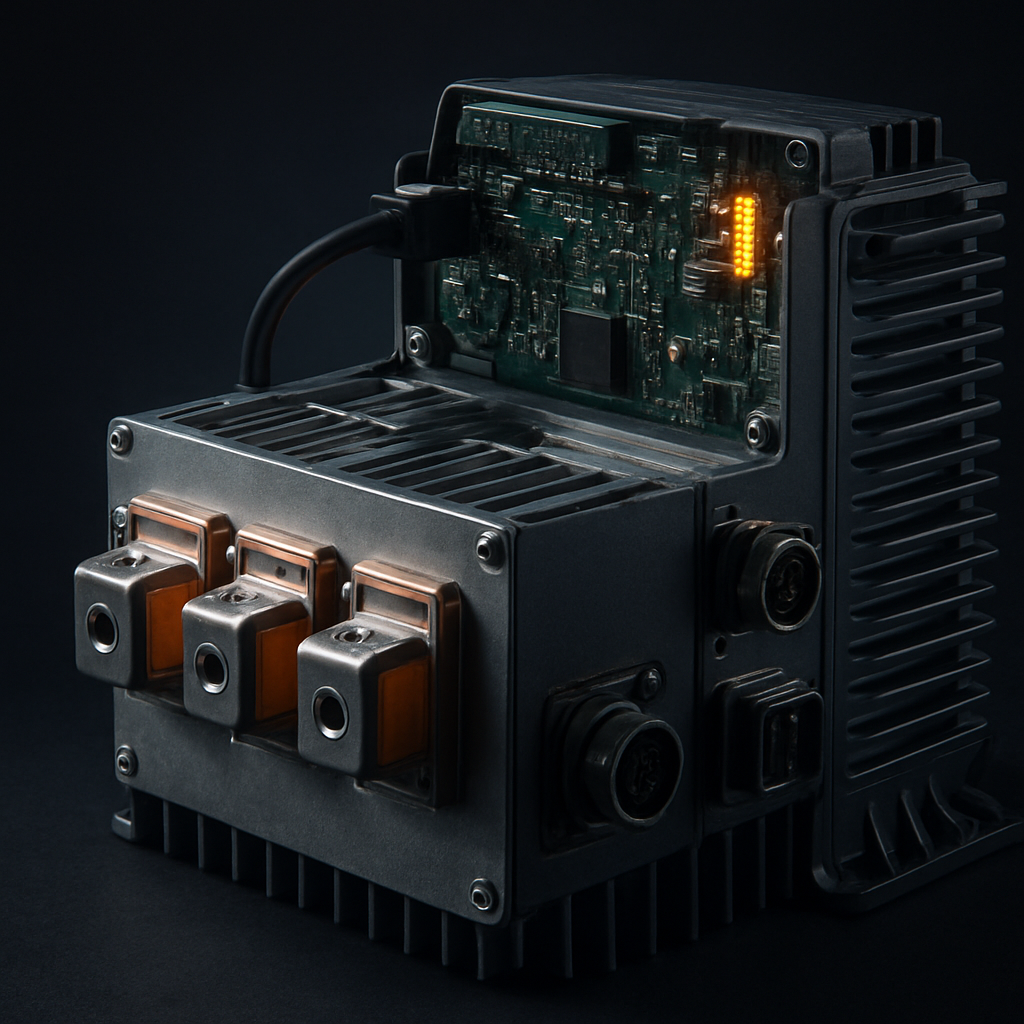
What is an IGBT Module?
The Insulated Gate Bipolar Transistor (IGBT) is the primary power switching device in modern frequency inverters, servo drives, and UPS systems. A typical 3-phase inverter contains 6 IGBT switches arranged in a bridge configuration. When one fails, the drive typically trips instantly on overcurrent or short-circuit.
Common Causes of IGBT Failure
- Overcurrent events: Motor short circuits, locked rotor at high current, wrong current limit settings
- Overvoltage on DC bus: Regenerative energy with insufficient braking resistor, utility voltage spikes
- Gate drive failure: The gate driver circuit can fail first, causing uncontrolled IGBT switching
- Thermal stress: Inadequate cooling, blocked heatsink, failed fan, thermal paste dried out
- Age and cycling: Wire bond fatigue after millions of thermal cycles
How to Confirm IGBT Failure
With the drive de-energized and DC bus capacitors discharged (wait 5+ minutes), use a multimeter in diode mode. Measure between each phase terminal (U, V, W) and both DC bus rails (+ and -). Healthy IGBTs show approximately 0.4–0.7V forward voltage drop. A reading near zero indicates a shorted device. An OL (overload) reading in both directions may indicate an open device.
Why Professional Repair Makes Sense
A replacement IGBT module for a 75kW ABB ACS880 costs €400–800. Total repair including module, gate driver inspection, DC bus capacitor testing, and firmware retention typically runs €600–1,200 — versus €8,000+ for a new unit. And delivery of a new unit can take 4–12 weeks. We typically complete IGBT repairs within 5 business days.