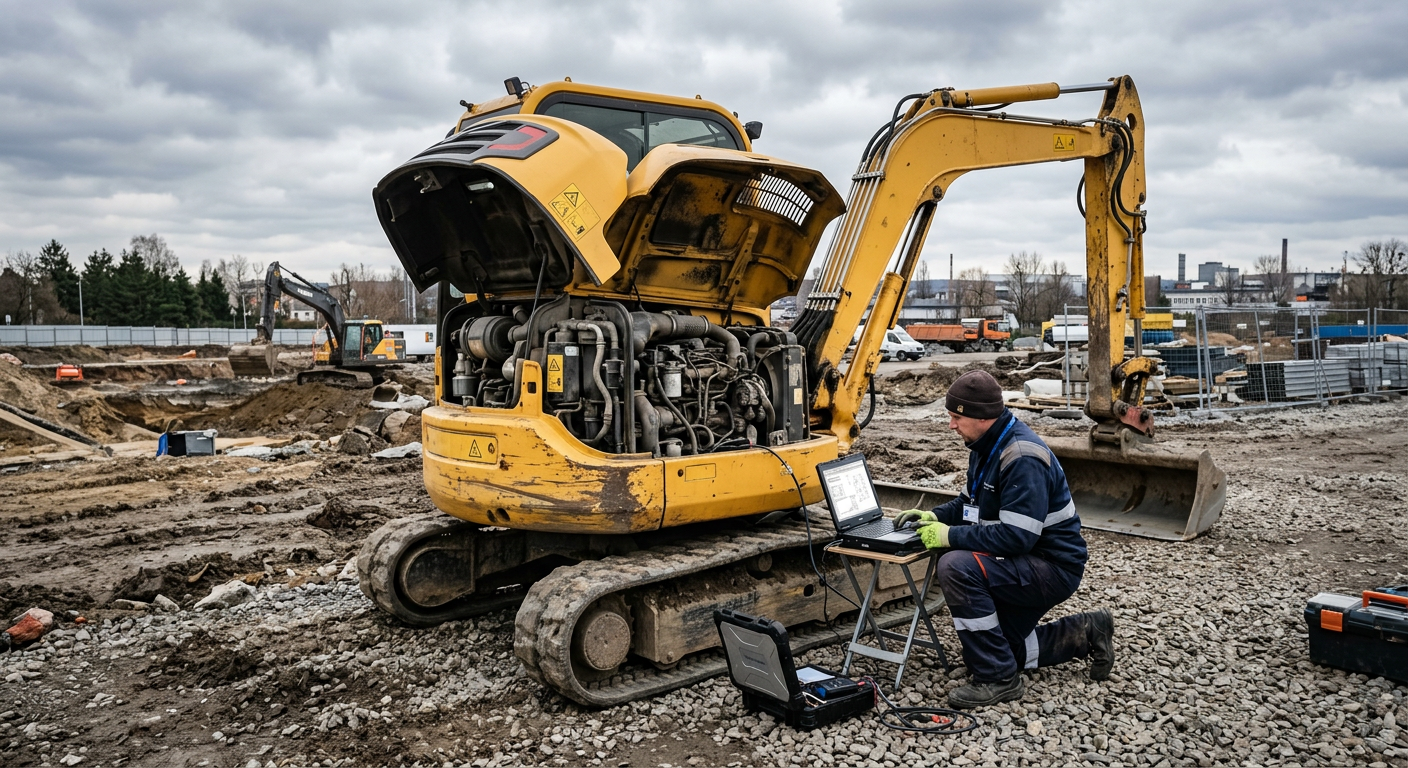
Kubota diesel engines power thousands of excavators, tractors, combine harvesters, wheel loaders, skid steers, and generator sets across Europe. Every modern common-rail Kubota engine relies on a DENSO-manufactured Engine Control Unit (ECU) to manage fuel injection timing, glow plug sequencing, exhaust after-treatment (DPF/DOC), and CAN communication with the machine's main controller. When a machine is caught in a flood, driven through deep water, or left standing in a waterlogged trench, water enters the ECU housing through the connector seals or cable glands — and the result is a dead engine that will not start, or one that starts and then stalls with cryptic fault codes.
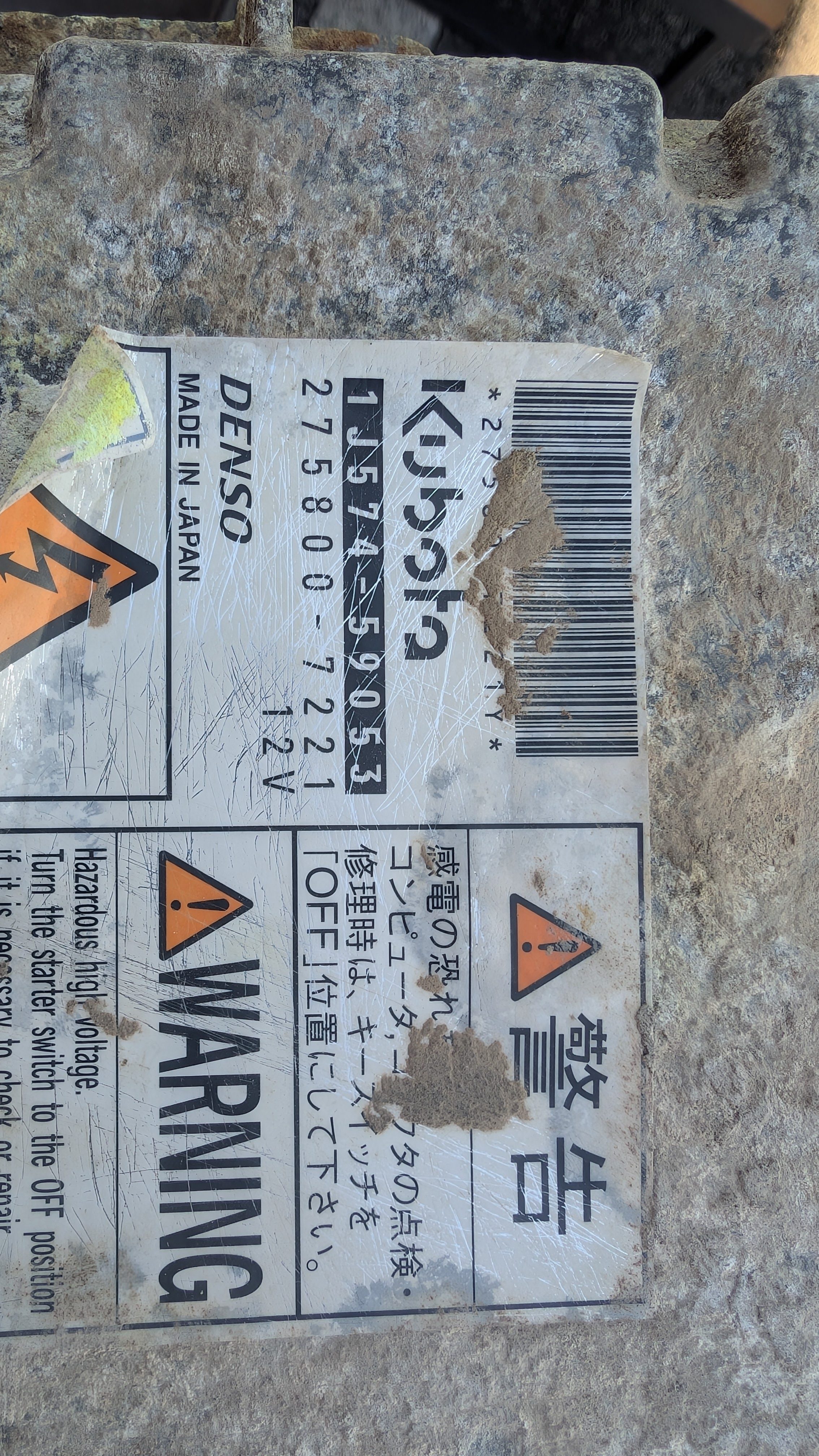
What We See on the Customer's Nameplate — DENSO Kubota ECU 1J574-59053 / 27580-7221
The ECU in the customer photo carries a DENSO, Made in Japan label with part number 1J574-59053 and reference number 27580-7221, rated at 12V. This part number range (275800-series DENSO reference, 1J574-series Kubota part number) corresponds to the ECU family used on the Kubota V3800 diesel engine — a 3.8-litre, 4-cylinder, common-rail turbo diesel found across Kubota's construction and agricultural equipment range. The label also carries a Japanese warning about electric shock risk and instructs the operator to turn the starter switch to the OFF position before inspecting or repairing the computer/key switch — standard DENSO safety text found on all Kubota engine ECUs of this generation.
Machines That Use This Kubota V3800 ECU (1J574-59053 / 27580-7221)
| Machine category | Models | Application |
|---|---|---|
| Excavators | Kubota KX080, KX121, U55, hydraulic excavators in the 5–8 tonne class using the V3800 engine | Construction, demolition, utility trenching |
| Tractors (M-series) | Kubota M108S, M126, M128, M-series utility and farm tractors | Field work, loader/backhoe attachments |
| Combine harvesters | Kubota ER112 and related ER-series combines | Grain harvesting |
| Wheel loaders / skid steers | Compact wheel loaders and skid steer loaders fitted with the V3800 power pack | Material handling, yard work |
| Generator sets (gensets) | Industrial and standby power generators built on the Kubota V3800 diesel block | Backup power, construction site power |
| Industrial power packs / pumps | OEM equipment using the V3800 as a bare engine or power unit | Irrigation pumps, compressors, hydraulic power units |
Because Kubota supplies the V3800 as a bare engine to dozens of OEMs (compact construction equipment brands, generator manufacturers, industrial pump builders), the same DENSO ECU part number appears under many different equipment brand names across Europe — the ECU itself, and its failure modes, remain identical.
How Water Gets Into a Kubota DENSO ECU
- Flooded engine bay: the machine is driven through water above the ECU mounting height, or parked in a flooded yard overnight. The 60-pin waterproof connector is only rated to a specific IP level and fails under sustained submersion or pressure washing.
- Damaged connector seal: the rubber gasket on the ECU connector or the cable gland degrades with age (UV, heat cycling, oil contamination), allowing slow moisture ingress even without full submersion.
- Condensation in cold storage: machines stored in unheated sheds through winter accumulate condensation inside the ECU housing, which corrodes pins over months without any single flooding event.
- Pressure washing: high-pressure cleaning directed at the engine bay forces water past connector seals that are only designed for splash resistance, not direct jet pressure.
Symptoms of a Water-Damaged Kubota ECU
| Symptom | Likely internal cause | Diagnostic check |
|---|---|---|
| Engine cranks but will not start | Corroded crankshaft/camshaft position sensor input pins on the connector, or corrosion on the main injector driver circuit shorting a channel to ground | Check for continuity/short between adjacent connector pins with power removed; visually inspect for green/white corrosion on pins 1–20 |
| Fault code E001 (general ECU fault) | Internal EEPROM or flash memory corruption from moisture reaching the main processor board | Connect Kubota Diagmaster and read the full fault log; E001 combined with intermittent faults points to internal board contamination |
| CAN communication failure (SPN 639) | Corrosion on the CAN H/CAN L pins of the ECU connector, or a failed CAN transceiver IC on the board after a moisture-induced short circuit | Measure CAN bus resistance at the ECU connector (should read 60 Ω with the network otherwise disconnected); inspect transceiver IC pins under magnification for green oxidation |
| Engine runs then enters limp/derate mode | Moisture-affected sensor input (rail pressure, boost pressure, or EGT sensor circuit) causing the ECU to protect the engine by limiting fueling | Read live sensor values on Diagmaster while running; a sensor reading that is stuck, noisy, or implausible under load indicates a corroded signal path |
| Display unresponsive / no power to ECU | Corrosion has bridged the 12V supply pin to ground inside the connector or on the board, blowing the ECU's internal fuse or damaging the power supply regulator | Measure resistance from the 12V pin to chassis ground with the battery disconnected — a low resistance reading confirms an internal short requiring board-level repair |
| Intermittent stalling in wet weather | Partially corroded pin creating a high-resistance connection that only fails once moisture film forms during rain | Spray connector lightly with water while engine runs on a test bench and observe for fault onset — confirms marginal corrosion not yet causing a permanent fault |
Our Component-Level Repair Process
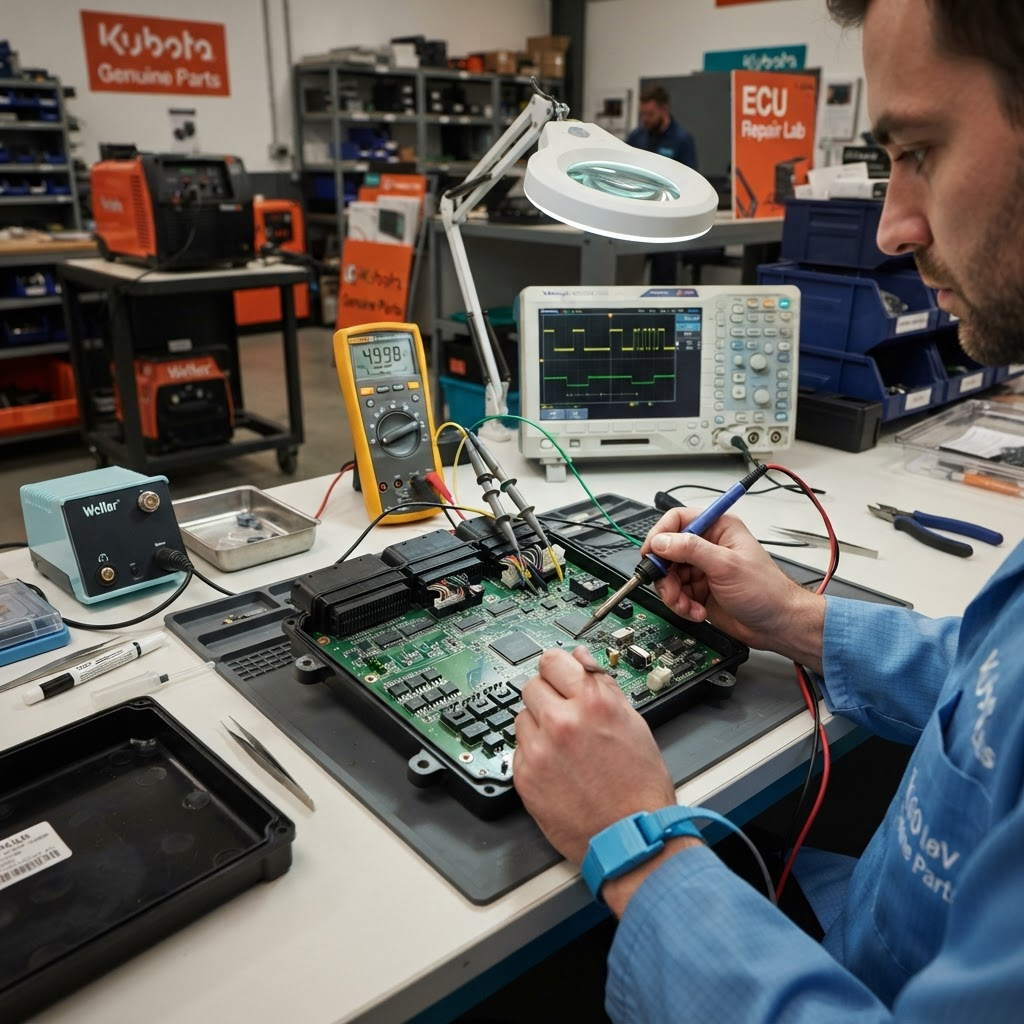
- Disassembly and visual inspection: the ECU housing is opened under ESD-safe conditions and the main board is inspected under magnification for corrosion, mineral deposits, and any burnt or discoloured components.
- Ultrasonic cleaning: the board is cleaned in an ultrasonic bath with isopropyl alcohol to remove mineral deposits and surface contamination without damaging surface-mount components.
- Connector pin restoration: corroded connector pins are cleaned, re-tinned, or replaced individually where corrosion has eaten into the base metal — a full connector replacement is used when damage is extensive.
- Component-level repair: any shorted or open component identified during electrical testing (regulator ICs, transceiver ICs, injector driver stages) is replaced with an exact or compatible equivalent.
- Conformal coating: after repair, the board is treated with a conformal coating to protect against future moisture ingress — a step not present on the original factory board and a meaningful upgrade for machines that operate in wet environments.
- Bench functional test: the repaired ECU is tested on a bench rig that simulates the engine harness, verifying all sensor inputs, injector driver outputs, and CAN communication before the unit is returned.
Service Area — Europe
We repair Kubota DENSO engine ECUs for customers across Poland (Gliwice, Knurow base — Katowice, Krakow, Wroclaw, Warsaw, Poznan, Gdansk), Germany (Berlin, Munich, Frankfurt, Stuttgart, Hamburg — DHL Express 1–2 business days), Czech Republic and Slovakia (Prague, Brno, Bratislava, Kosice — DPD 1–2 days), Italy (Milan, Rome, Turin, Bologna — DHL 2–3 days), and the rest of Europe via DHL/DPD courier, typically 2–5 business days. Free return shipping both ways for repairs above 3,000 PLN (approx. €700).
FAQ
- My Kubota V3800 excavator ECU was submerged in flood water overnight. Is it worth repairing?
- In most cases yes. Submersion damage is almost always confined to the connector pins and surface corrosion on the board — the multilayer PCB itself and most components survive brief submersion if cleaned and dried within a reasonable time. We strongly recommend not attempting to power the ECU on before it has been professionally cleaned, since applying voltage to a moisture-contaminated board is what causes secondary short-circuit damage that turns a cleanable ECU into a scrap one.
- The part number on my ECU is 1J574-59053 with reference 27580-7221 — is this the exact unit in your article?
- Yes, this is the identical DENSO ECU shown in our customer photo, used on the Kubota V3800 engine across excavators, M-series tractors, and ER-series combine harvesters. If your tag shows this part number, the repair procedures and fault patterns described above apply directly to your unit.
- How do I know if my Kubota ECU failure is water damage rather than a normal electronic fault?
- Water damage typically shows as intermittent or weather-dependent faults (works fine when dry, fails or stalls in rain), visible corrosion on connector pins when disconnected, or a combination of unrelated fault codes appearing together (a genuine component failure usually produces one consistent, repeatable fault). If your machine was recently driven through standing water, parked in a flooded area, or pressure-washed directly at the engine bay, water ingress should be the first suspect.
- Can you repair the ECU without removing it from the machine?
- No — board-level repair requires the ECU to be removed and opened in a controlled ESD-safe environment with ultrasonic cleaning equipment and bench test rigs that are not available on-site. Send the removed ECU to us; we return it fully cleaned, repaired, conformal-coated, and bench-tested, ready to bolt back onto the harness.