Kubota equipment — M, L, B, MX, GR, and BX series tractors, KX and U excavators, mini excavators, R-series wheel loaders, SVL track loaders, generator sets, and other construction and agricultural machines — relies on several independent electronic controllers communicating over a CAN bus. This isn't a single "box" that's easy to swap: the engine has its own ECU, the hydraulics have their own EPOS controller, the cabin has its own monitor panel, and the machine often has an additional MAIN/VSM module tying everything together. A failure in each of these components looks different and requires different diagnostics — so we've put together a full overview of the Kubota controllers we repair and their typical faults.
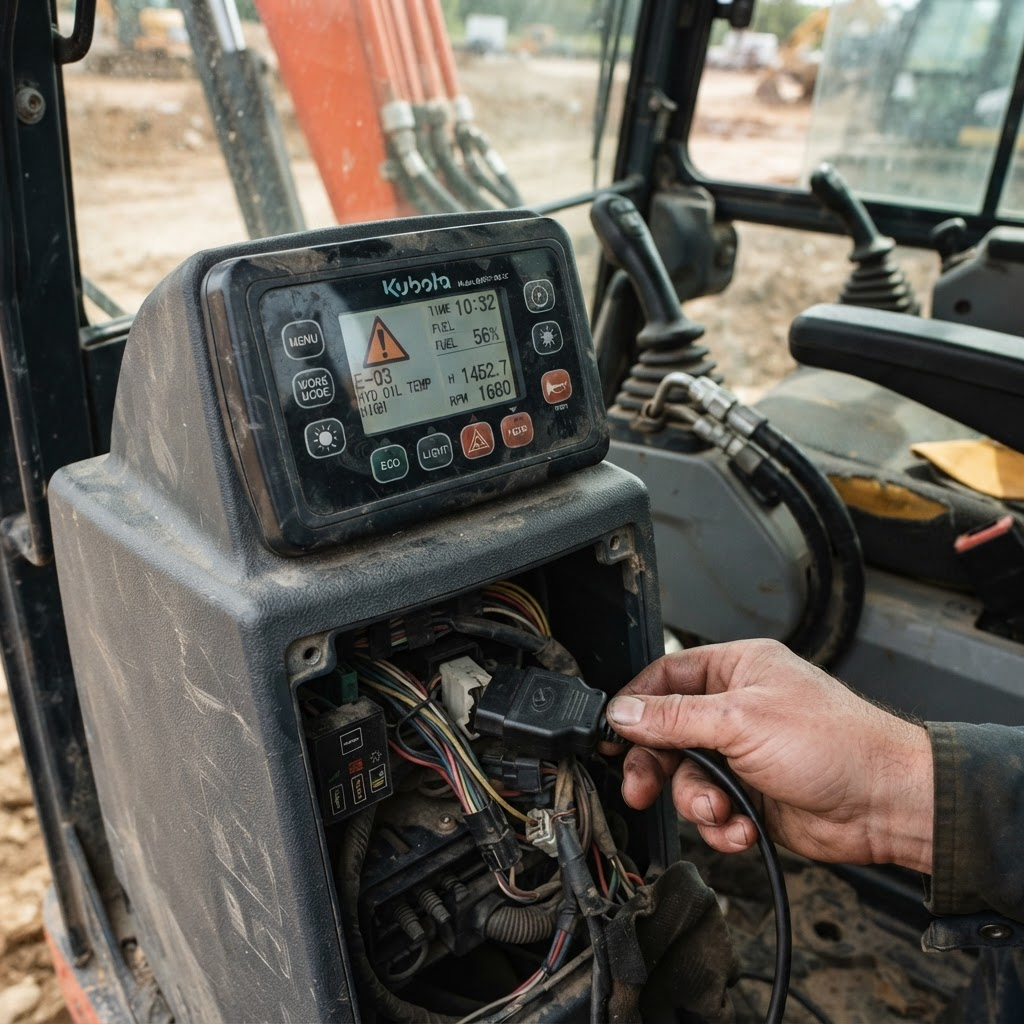
Types of Controllers in Kubota Machines
| Controller | Function | Typical part numbers / location |
|---|---|---|
| Engine ECU | Manages fuel injection, glow/ignition, DPF, engine speed | Denso 1J574-xxxxx, 27xxx-xxxx; D722, D902, V1505, V2403, V3307, V3800 engines |
| MAIN / VSM (Vehicle System Monitor) | Central machine module — CAN communication, immobilizer, operating function control | RD458-xxxxx, LC33EX, 9842771-x; KX, U excavators, mini excavators |
| EPOS (Electronic Power Optimizing System) | Hydraulic pump controller — optimizes engine power and hydraulic performance | mounted on or near the hydraulic pump, KX080 and larger excavators, SVL loaders |
| Monitor panel / cabin display | Operator interface — readouts, error codes, auto-idle settings | cabin console, excavators, SVL loaders, MX/M tractors |
| Glow control unit / safety relay | Glow plug control, start lockout, ignition relays | B, BX compact tractors, mowers |
Kubota Machines We Service
- Agricultural and municipal tractors: M5, M6, M7, M108S, M126, M128, L3301, L5460, GR, BX, B2301, MX series
- Excavators and mini excavators: KX016-4, KX040-4, KX057-4, KX080-4α, KX121, U17, U35, U55
- Track and wheel loaders: SVL65-2, SVL75-2, SVL95-2S, R series
- Generator sets and combines: units with V3800 engines, ER112
Engine ECU Faults
- No spark, no injector firing — codes P0301–P0304, damaged injector driver transistors on the ECU board.
- Codes P0320, P0335 — damaged crank/speed sensor circuit or its input on the controller.
- E:030 EEPROM error — lost or corrupted controller configuration memory.
- DPF errors E:210, E:225 — a problem with particulate filter regeneration, heater control, or differential pressure sensor.
- CAN communication loss, SPN 639 — typically after water ingress, connector pin corrosion on the Denso controller.

MAIN/VSM and EPOS Controller Faults
- No CAN communication with the monitor panel — the machine won't start or the panel shows a blank readout.
- Immobilizer blocking start after losing sync with the main module — requires memory or communication interface repair.
- Auto-idle fault — the controller doesn't respond to joystick input, engine speed doesn't drop at idle.
- Loss of EPOS power optimization — reduced hydraulic performance under full engine load, a typical symptom of a damaged sensor or output driver on the pump controller.
- Connector corrosion from a humid construction site environment — intermittent signals, random fault reporting.
Monitor Panel and Glow Control Unit Faults
- Black or flickering display with power present — damaged backlight or internal panel power supply.
- Stuck membrane buttons after moisture and construction dust ingress.
- Engine won't start despite a good battery — a damaged glow control unit or safety relay blocking the start circuit.

Why Component-Level Repair Instead of Replacement
Genuine Kubota controllers — especially MAIN/VSM and EPOS modules — are hard to source outside an authorized dealer network, cost several times more than a repair, and are often paired with a specific machine (immobilizer, serial number). Component-level repair preserves the original pairing and programmed configuration, eliminating the need to recalibrate the entire machine at a dealer.
Our Diagnostic and Repair Process
- Controller and machine identification: Kubota model, module part number, symptom and fault code description.
- Bench diagnostics: simulating input signals, testing CAN communication, measuring supply and output voltages.
- Component-level fault isolation: checking driver transistors, capacitors, EEPROM memory, inspecting connectors under a microscope.
- Component-level repair: replacing damaged components, restoring connectors, ultrasonic cleaning after water damage, re-soldering PCB traces.
- Functional test: verifying CAN communication with the panel and main module before shipping back to the customer.
Who We Serve
We work with construction and agricultural equipment service shops, rental companies, Kubota dealers, and private equipment owners across Europe. The scope and quote for each repair are determined individually after the controller is delivered for diagnostics.
Service Area
We serve customers across Poland and Europe — Germany, Italy, Czech Republic, and Slovakia — via courier shipment, with our base in Knurow near Gliwice, Poland. Standard working hours are 8:00 AM to 4:00 PM, Monday through Friday.
FAQ
- My Kubota tractor won't start despite a good battery — what should I check first?
- A common cause is a damaged glow control unit or safety relay blocking the start circuit, rather than the engine ECU itself. Bench diagnostics can confirm this precisely.
- My Kubota KX excavator reports error E:030 and loses communication with the panel — is that the MAIN controller?
- Yes, error E:030 usually indicates EEPROM memory damage in the MAIN/VSM module. We repair this at the component level, preserving the original pairing with the machine.
- Do you repair the EPOS hydraulic pump controller?
- Yes, including loss of power optimization, no response to joysticks, and damaged input sensors on the controller.
- Does the controller need to be re-paired with the machine at a dealer after repair?
- We always aim to preserve the original configuration and pairing stored in the controller memory, so in most cases dealer recalibration isn't needed.