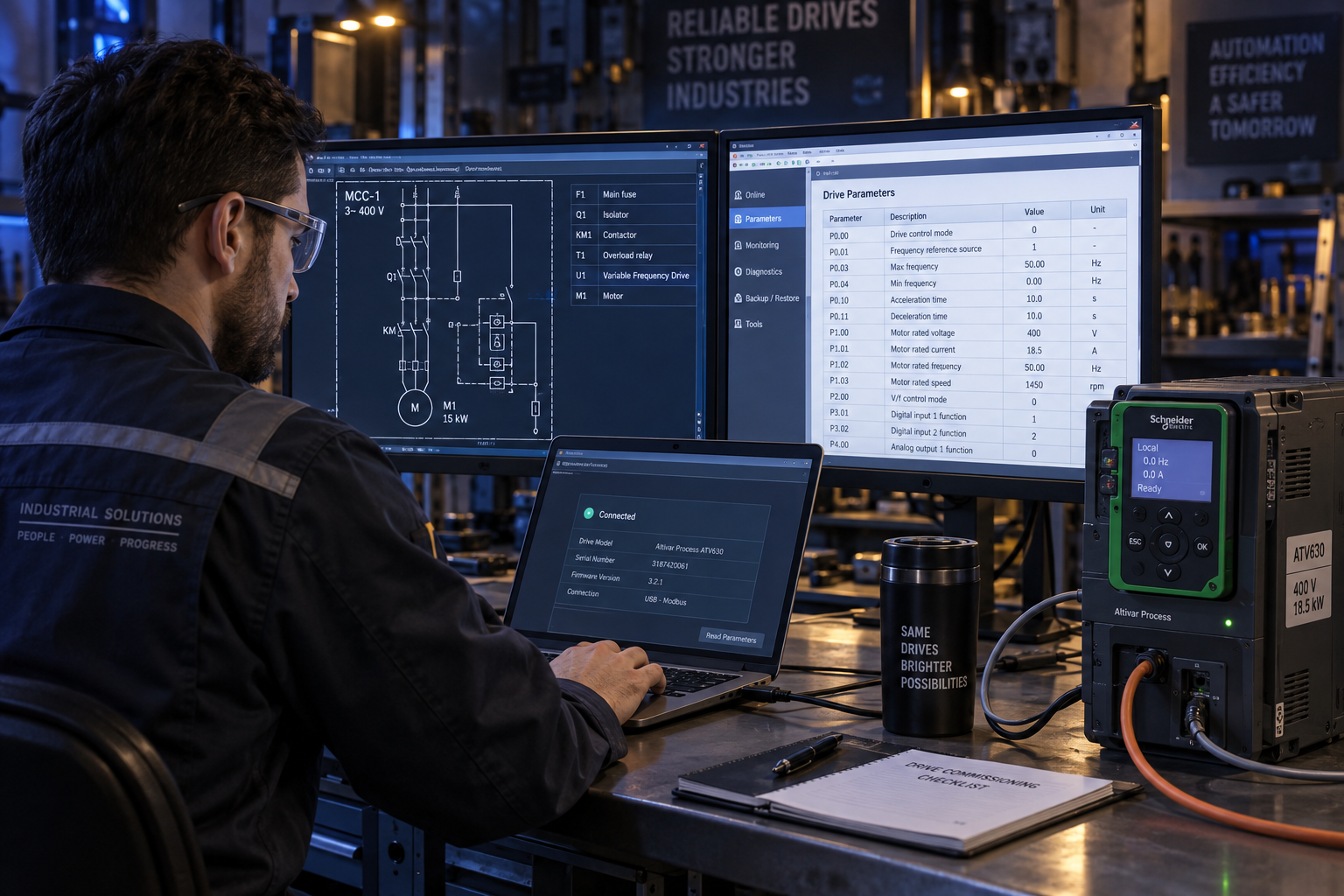
Your VFD needs replacing, but the original is not on the market? You have two options
A drive failure on a production line is always time pressure. The problem gets worse when the exact model — for example an ABB ACS550, a Danfoss FC302, or a Siemens Micromaster 440 — has been discontinued, and the distributor's lead time for a genuine replacement is 8-14 weeks. In that situation there are two realistic paths: reprogramming the existing unit (if it can still be repaired or sourced used) or replacing it with a different brand of comparable rating, reprogrammed so it behaves identically to the original as far as the PLC, the motor, and the operator are concerned.
Both paths require detailed knowledge of the plant's electrical schematic, the I/O signal map, and the supervisory control logic — which is why we deliver this service remotely, based on the schematic, the motor nameplate, and a parameter dump from the old unit (if it still runs) submitted by the customer.
Reprogramming or cross-brand replacement? How to decide
Reprogramming — when it makes sense
If the drive is electrically sound (no shorted IGBT module, no damaged control board) and the issue is a configuration problem after a motor swap, lost parameters after a power outage, a need to change the ramp/torque profile, or adding a new operating mode (multi-speed, pump PID) — reprogramming alone is enough. It is the fastest and cheapest option, typically completed remotely in 1-3 days.
Cross-brand replacement — when it is necessary
Switching to a different manufacturer becomes necessary when the original model is permanently unavailable (discontinued, no spare parts on the secondary market), the unit has a hardware fault that cannot be repaired within a reasonable time, or the customer wants to standardize the plant fleet on one service brand. The key here is reproducing identical functionality — the same digital and analog inputs/outputs, the same PLC communication protocol (Profibus, Profinet, Modbus RTU, CANopen), and the same motor torque characteristic — so that not a single line of the PLC program needs to change.
Cross-brand compatibility table for major VFD manufacturers
| Original drive | Proven replacement | What to watch for |
|---|---|---|
| ABB ACS550 / ACS355 | Danfoss FC202 / FC302, Siemens G120X | Digital input DI1-DI6 terminal numbering differs — the function list needs to be reprogrammed |
| Siemens Micromaster 440 / 430 | Siemens G120C (same manufacturer, new platform), ABB ACS580 | Profibus DP requires a different GSD file configuration on the S7 PLC side |
| Danfoss VLT FC302 / FC202 | ABB ACS880, Schneider Altivar ATV600 | Torque profile (V/f vs vector) must be manually matched to the load characteristic (pump, fan, conveyor) |
| Schneider Altivar ATV71 / ATV31 | Danfoss FC302, Lenze i550 | Modbus RTU register addressing differs — the register map in SCADA/HMI must be rewritten |
| Lenze 8200 vector / i550 | SEW-Eurodrive MOVITRAC, Siemens G120 | Incremental encoder requires a different expansion card type — check signal compatibility |
| Yaskawa A1000 / V1000 | Mitsubishi FR-A800, ABB ACS880 | Safety functions (STO — Safe Torque Off) must be certified for the same machine safety category |
| Fuji Frenic / Mitsubishi FR-E700 | Danfoss FC102, Siemens G120C | Overload curve (150%/60s vs 110%/60s) affects motor sizing — must be verified |
How remote VFD reprogramming based on a schematic works
90% of the work in a drive swap is correct parameter configuration — not the physical installation. That is why we deliver this service remotely, without a site visit, based on documentation the customer submits:
- Gathering documentation. The customer sends a photo/scan of the control cabinet's electrical schematic, the motor nameplate (power, voltage, rated current, cos φ, speed), a photo of the old drive's nameplate, and — if the unit still runs — a screenshot or list of the current parameters from the operator panel.
- Control logic analysis. We check how the drive talks to the PLC/HMI — start/stop signals, direction, speed reference (0-10V, 4-20mA, digital via fieldbus), feedback signals (ready, fault, actual speed). This determines which parameters must be mapped 1:1.
- Parameter set preparation. We build the complete list of parameters to upload — starting torque, acceleration/deceleration ramps, PWM carrier frequency, motor control mode (linear V/f, quadratic V/f for pumps/fans, sensorless vector), motor thermal protection (I2t), and I/O configuration.
- Remote upload and test. We deliver the configuration as a ready parameter file (if the drive supports it) or as a step-by-step instruction to enter from the panel — over a remote connection via VPN/TeamViewer to the customer's local computer, or via Ethernet/USB to the drive if the plant network allows it.
- Trial start-up and correction. During the first start under load we remotely monitor motor current, running vibration, and command response time — correcting ramp/torque parameters live until behavior matches the previous drive exactly.
Cross-brand VFD replacement process — step by step
- Diagnosis and decision. We confirm the original is unavailable or uneconomical to repair, and select a replacement of matching power, voltage class, and safety functions (STO, if required by the machine).
- Sourcing the replacement unit. Acting as an intermediary, we help purchase the correct model — with the right firmware version and communication cards (Profinet, Profibus, EtherCAT, Modbus) compatible with the existing PLC.
- Mechanical and electrical installation. Physical swap — the new drive is mounted in the same cabinet, keeping terminal numbering where possible to simplify as-built documentation.
- Remote configuration per the prepared parameter set — see the section above.
- PLC/SCADA integration. If the communication protocol changed (e.g. from Profibus to Profinet), we update the function block in the PLC program (Siemens TIA Portal, Step 7) so variable addresses remain unchanged for the rest of the production logic.
- Acceptance testing and documentation. We hand over the parameter record, an updated electrical schematic with changes noted, and instructions for the maintenance team.
Most common mistakes in a DIY VFD swap (and how we avoid them)
| Mistake | Consequence | How we avoid it remotely |
|---|---|---|
| Copying parameters 1:1 without accounting for a different motor control platform | Vibration, motor overheating, I2t protection tripping | We recalculate torque and ramp parameters for the specific characteristic of the new drive, never copy directly |
| Ignoring the difference in digital input mapping between brands | Drive won't start, wrong start/stop sequence | We analyze the schematic and map input functions before uploading parameters |
| No verification of communication card compatibility with the PLC | No communication, PLC program timeout, line stoppage | We check the PLC firmware version and required GSD/GSDML file before ordering the card |
| Incorrectly set PWM carrier frequency | Noisy motor operation, extra heat losses, EMC interference | We select the carrier frequency for motor cable length and load type |
Service area: on-site in Poland, remote across Europe
We perform the physical installation and swap on-site in the Silesia and Opole regions of Poland: Katowice, Gliwice, Zabrze, Bytom, Ruda Śląska, Rybnik, Tychy, Chorzów, Sosnowiec, Opole, Kędzierzyn-Koźle, Nysa.
Reprogramming and parameter configuration itself is delivered remotely across all of Europe — we have completed remote implementations for plants in Germany (Berlin, Munich, Hamburg, Cologne), the Czech Republic (Prague, Ostrava, Brno), Slovakia (Bratislava, Košice), Italy (Milan, Turin, Bologna), Austria (Vienna, Linz), and France, the Netherlands, and Belgium. If your plant has network access to the drive, or can send us photos/schematic and a parameter dump, we configure it remotely without a technician visit.
FAQ — VFD replacement and reprogramming
- Can I install a different-brand drive without changing the PLC program?
- Yes, if we preserve the same communication protocol and the same I/O signal layout — we configure the new drive to be "invisible" to the PLC program, behaving identically to the original.
- How long does remote VFD reprogramming take?
- Typically 1-3 business days from receiving the complete schematic and motor data. Complex cases involving fieldbus integration may take up to 5 days.
- Do you need physical access to the drive?
- No, if the drive has an Ethernet/USB port reachable from the plant network, or the customer can enter parameters from the operator panel following our step-by-step instructions during a remote session.
- What information do I need to prepare before contacting you?
- A photo of the cabinet's electrical schematic, the motor nameplate, the old drive's nameplate, and — if it still runs — a dump of the current parameters.
- Do you also handle HVAC pump and fan drives?
- Yes — in that case, correctly setting the quadratic torque profile and the pump/fan PID control function is critical.