Military-grade power electronics rely on the same component families we service daily in industrial applications — rectifiers, DC-DC converters, voltage regulators, and battery charging controllers — built to withstand vibration, moisture, dust, and extreme temperature ranges (specifications aligned with MIL-STD-810 style requirements). We service power electronics used in military vehicles, field generator sets, battery chargers for heavy defense equipment, and onboard power converters, at the component level, with full diagnostics and a final bench test.
Military Vehicle Rectifiers and Alternators — Brands and Models We Service
| Vehicle / platform | Component type | Common fault |
|---|---|---|
| Star 266, Star 1466 (Dzik) | Alternator with rectifier bridge, voltage regulator | Burnt rectifier diodes, shorted stator winding, faulty voltage regulator (charging voltage too low or too high) |
| Jelcz 442, Jelcz 662, Jelcz P882 | Alternator, charging rectifier, charging relay | Corroded brushes and slip rings, damaged diode bridge, open field circuit |
| Rosomak (KTO / IFV) | Onboard power supply, 24V/28V DC-DC converter, battery charging module | Failed MOSFET/IGBT transistors in the converter module, overheating from a clogged heat sink, damaged sealed connectors |
| Honker, Tarpan Honker | 24V alternator, charging rectifier | Worn brushes, burnt diodes, faulty voltage regulator |
| Leopard 2, PT-91, T-72 (tracked vehicles) | High-current rectifiers for onboard battery charging, generator voltage regulators | Thyristor/diode bridge failures under heavy load, surges from the onboard electrical system |
Military Battery Chargers and Stationary Rectifiers — Tanks, Radar, Field Equipment
Beyond vehicle-mounted systems, we also service stationary and mobile battery chargers used to charge onboard batteries in tanks, armored vehicles, radar stations, and communications equipment in the field. These are typically high-current thyristor or transistor rectifiers, produced by manufacturers specializing in military power supplies such as Statcon Energiaa, Pivotal Power (DRS), Milpower Source, Lincad, KOLT Power, and Comrod, as well as domestic special-purpose power supply manufacturers. Common faults include:
- Failed thyristor or power transistor modules — no output voltage or unstable charging
- Faulty charge current/voltage regulation circuit — the charger fails to switch from fast charge to maintenance trickle charge
- Damaged output relays and contactors — intermittent operation under load
- Corrosion and mechanical damage to sealed connectors after field deployment
- Damaged control transformers and filter chokes from overload
Onboard Power Supplies and DC-DC Converters
Military vehicles and specialized equipment use DC-DC converters to power communications, targeting, navigation, and lighting systems from the 24V/28V onboard supply. We repair:
- Onboard DC-DC converters (24V/28V to 12V, 5V, 3.3V for specialized equipment electronics)
- Switching power supplies for radios and communications equipment
- Power modules for imaging and targeting systems
- EMI/EMC filter circuits in onboard power supply lines
Field Generator Sets — Voltage Regulators (AVR) and Controllers
Field generator sets powering command posts, radar systems, communications gear, and military encampments require functioning automatic voltage regulators (AVR) and engine controllers. We service field generator electronics produced by manufacturers such as Dewey Electronics, as well as licensed and domestically produced generator sets, including:
- AVR voltage regulators — failed output transistors, burnt trim potentiometers, damaged feedback amplifier circuits
- Engine controllers (generator ECU modules) — start-up faults, loss of communication with the control panel
- Generator control and metering panels — damaged displays, phase-switching relays
- Synchronization modules for parallel generator operation
Our Diagnostic and Repair Process for Military Power Electronics
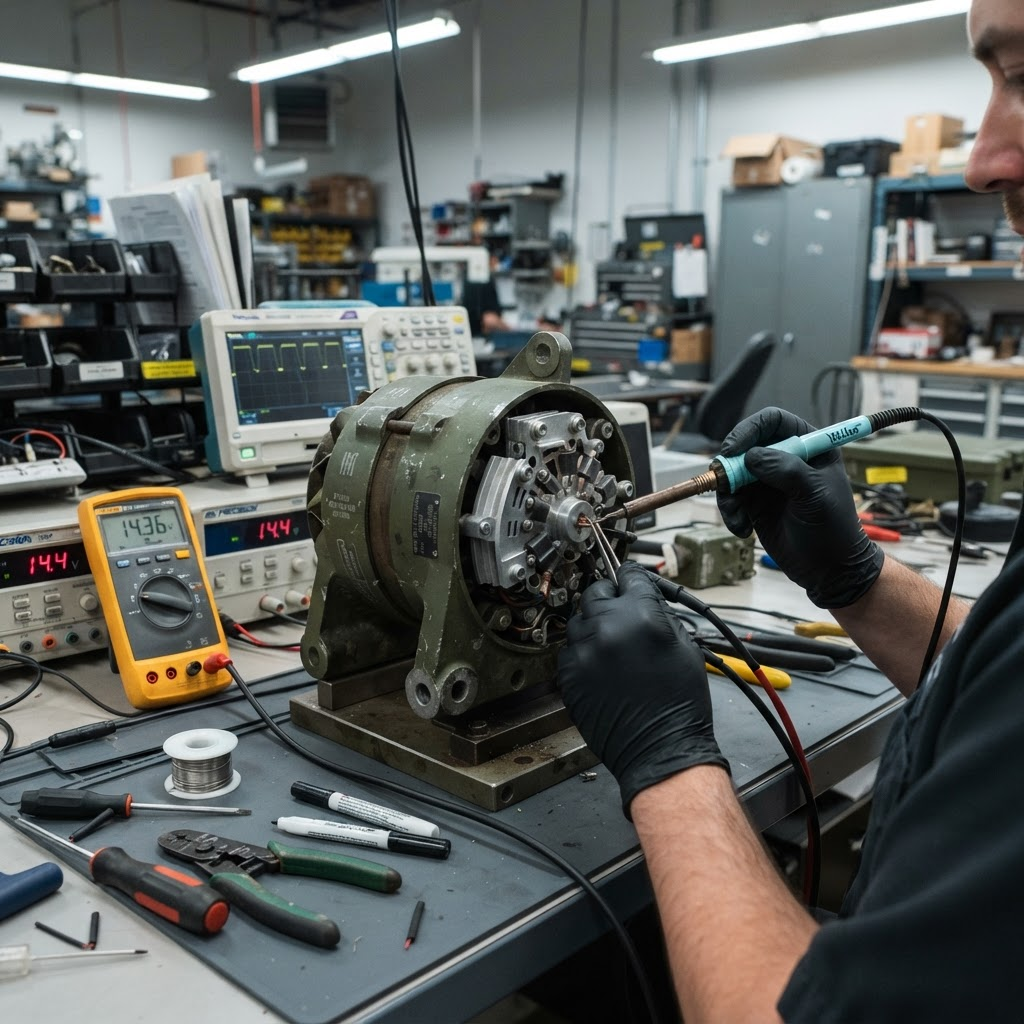
- Intake and initial assessment: visual inspection, checking part markings, catalog numbers, and any technical documentation provided.
- Bench diagnostics: measuring output voltages, load currents, and checking operation under simulated real-world load conditions.
- Component-level fault isolation: diode tests on rectifier bridges, checking MOSFET/IGBT power transistors and thyristors, verifying control and feedback circuits.
- Component-level repair: replacing damaged diodes, transistors, and filter capacitors, restoring or replacing sealed connectors and relays.
- Final load test: verifying output parameters against technical specifications (charging voltage, stability, response to load changes) before return.
- Repair documentation: a before-and-after measurement report for the customer's technical records.
Who We Serve
We work with logistics units, technical workshops, external contractors performing component regeneration for military units, and civilian companies technically supporting fleets of special vehicles and field equipment. Work is carried out at our workshop in Knurow, Poland — the scope and quote for each repair are determined individually after the unit is delivered for diagnostics.
Service Area
We serve customers across Poland — Warsaw, Krakow, Wroclaw, Poznan, Gdansk, Katowice, Lodz, Szczecin, Bydgoszcz, Lublin, Rzeszow — with priority given to the Silesian region around our base in Knurow (Gliwice, Zabrze, Bytom, Rybnik, Tychy). We also serve defense contractors and technical workshops across Europe — Germany, Italy, Czech Republic, and Slovakia — via courier shipment. Standard working hours are 8:00 AM to 4:00 PM, Monday through Friday.
FAQ
- Can you repair rectifiers and chargers without original manufacturer documentation?
- In many cases, yes — component-level diagnostics (diode tests, power transistor checks, control circuit verification) do not always require access to full factory documentation. When documentation is available, it significantly speeds up the process and allows precise post-repair verification.
- Do you accept equipment delivered by military units or external contractors?
- Yes, we work with logistics units and companies performing component regeneration and service on behalf of military units. Each order is handled individually, with full technical documentation of the work performed.
- How long does a military rectifier or charger repair take?
- Repair time depends on the extent of damage and the availability of replacement power components (transistors, thyristors, transformers). After initial diagnostics we provide an estimated timeline for each individual order.
- Do you perform load testing after the repair?
- Yes, every repaired unit undergoes a functional test under simulated load on our bench before it is returned — we verify output voltage, operating stability, and response to load changes.